
713-222-7211 Call For A Free Consultation
Blog
How Do You Benefit From a Class Action Lawsuit?
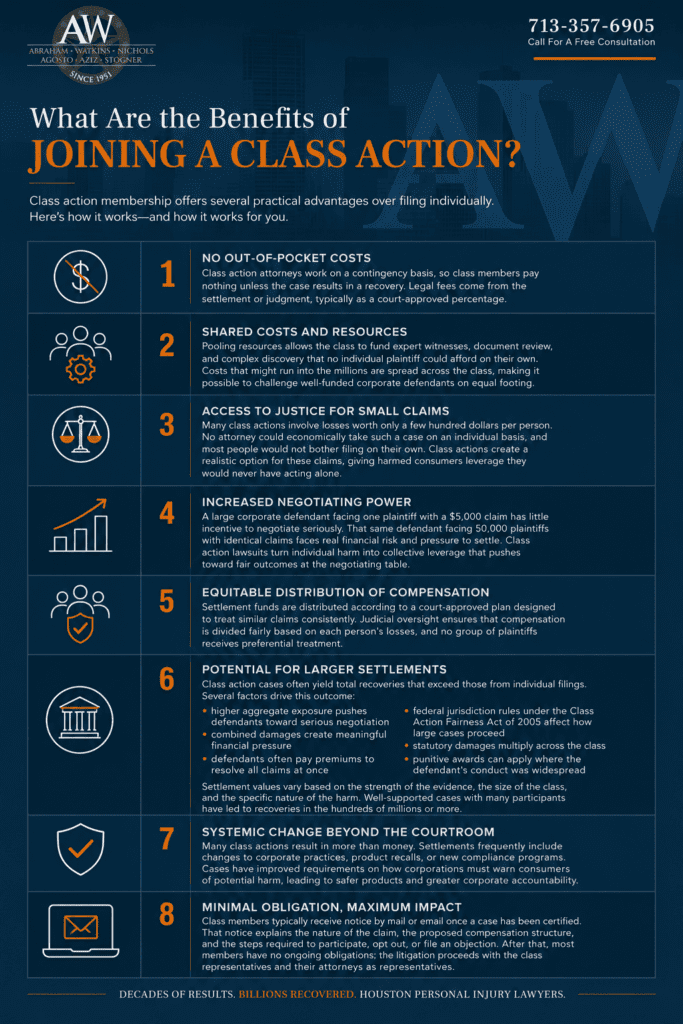 Joining a class action lawsuit allows a group of people with similar injuries to pursue a single consolidated case rather than filing separately. The structure spreads litigation costs across all members, simplifies individual participation, and creates a realistic path to compensation for claims that would be too small to pursue on their own. If you were harmed alongside thousands of others by the same product, drug, or corporate decision, a class action may be your most practical option.
What Is a Class Action Lawsuit?
A class action is a civil case in which one or more people, called class representatives, sue on behalf of a larger group with similar claims against the same defendant. At the federal level, Federal Rule of Civil Procedure 23 governs the requirements for filing a class action and for how these cases proceed, and Texas Rule of Civil Procedure 42 follows comparable requirements and procedural rules.
Not every dispute involving multiple people qualifies for a class action. First, four prerequisites must all be met:
- the class is too large for all members to be joined in a single lawsuit;
- the members share common legal or factual questions;
- the representative plaintiffs have claims typical of the broader class; and
- the representatives can fairly and adequately protect the interests of all class members.
The case must also fit into at least one of three recognized categories of class action:
- separate individual lawsuits would risk inconsistent rulings or conflicting legal obligations;
- the opposing party acted or refused to act in a way that affects the entire class, making a single court order the most appropriate remedy; or
- common legal or factual questions outweigh individual ones, and a class action is the most efficient and fair way to resolve the dispute.
What Are the Benefits of Joining a Class Action?
Class action membership offers several practical advantages over filing individually. Class members typically receive notice by mail or email once a case has been certified. That notice explains the nature of the claim, the proposed compensation structure, and the steps required to participate, opt out, or file an objection. After that, most members have no ongoing obligations; the litigation proceeds with the class representatives and their attorneys as representatives.
No Out-of-Pocket Costs
Class action attorneys work on a contingency basis, so class members pay nothing unless the case results in a recovery. Legal fees come from the settlement or judgment, typically as a court-approved percentage.
Shared Costs and Resources
Pooling resources allows the class to fund expert witnesses, document review, and complex discovery that no individual plaintiff could afford on their own. Costs that might run into the millions are spread across the class, making it possible to challenge well-funded corporate defendants on equal footing.
Access to Justice for Small Claims
Many class actions involve losses worth only a few hundred dollars per person. No attorney could economically take such a case on an individual basis, and most people would not bother filing on their own. Class actions create a realistic option for these claims, giving harmed consumers leverage they would never have acting alone.
Increased Negotiating Power
A large corporate defendant facing one plaintiff with a $5,000 claim has little incentive to negotiate seriously. That same defendant facing 50,000 plaintiffs with identical claims faces real financial risk and pressure to settle. Class action lawsuits turn individual harm into collective leverage that pushes toward fair outcomes at the negotiating table.
Equitable Distribution of Compensation
Settlement funds are distributed according to a court-approved plan designed to treat similar claims consistently. Judicial oversight ensures that compensation is divided fairly based on each person’s losses, and no group of plaintiffs receives preferential treatment.
Potential for Larger Settlements
Class action cases often yield total recoveries that exceed those from individual filings. Several factors drive this outcome:
- higher aggregate exposure pushes defendants toward serious negotiation;
- combined damages create meaningful financial pressure;
- defendants often pay premiums to resolve all claims at once;
- federal jurisdiction rules under the Class Action Fairness Act of 2005 affect how large cases proceed;
- statutory damages multiply across the class; and
- punitive awards can apply where the defendant’s conduct was widespread.
Settlement values vary based on the strength of the evidence, the size of the class, and the specific nature of the harm. Well-supported cases with many participants have led to recoveries in the hundreds of millions or more.
Systemic Change Beyond the Courtroom
Many class actions result in more than money. Settlements frequently include changes to corporate practices, product recalls, or new compliance programs. Cases have improved requirements on how corporations must warn consumers of potential harm, leading to safer products and greater corporate accountability.
Common Reasons for Class Action Lawsuits
Class actions can address unfair corporate practices like price gouging, but they are particularly common in personal injury scenarios. Some examples include:
- defective products, including airbags, tires, and other vehicle components;
- dangerous drugs and supplements;
- defective or recalled medical devices;
- toxic torts involving chemicals linked to cancer;
- workplace explosions causing widespread injury; and
- environmental contamination affecting nearby residents.
If many people suffered similar injuries from the same cause, discuss a possible class action with an injury lawyer. In some cases, a class action is the more beneficial path to take to seek compensation, and an experienced attorney can weigh your options between an individual claim and a class action.
Talk to Our Houston Class Action Injury Attorneys
If you think your personal injury might qualify for a class action, our team at Abraham, Watkins, Nichols, Agosto, Aziz & Stogner can evaluate the facts, determine whether a case is already pending, and explain your options. We know the benefits of class actions and regularly explore these cases as possibilities for our clients.
Our attorneys have represented Houstonians for over 75 years and handle class action and injury cases on a contingency basis. We believe everyone deserves access to high-quality legal representation without an upfront cost. Call us at (713) 222-7211, or contact us online to schedule your free consultation today.
Joining a class action lawsuit allows a group of people with similar injuries to pursue a single consolidated case rather than filing separately. The structure spreads litigation costs across all members, simplifies individual participation, and creates a realistic path to compensation for claims that would be too small to pursue on their own. If you were harmed alongside thousands of others by the same product, drug, or corporate decision, a class action may be your most practical option.
What Is a Class Action Lawsuit?
A class action is a civil case in which one or more people, called class representatives, sue on behalf of a larger group with similar claims against the same defendant. At the federal level, Federal Rule of Civil Procedure 23 governs the requirements for filing a class action and for how these cases proceed, and Texas Rule of Civil Procedure 42 follows comparable requirements and procedural rules.
Not every dispute involving multiple people qualifies for a class action. First, four prerequisites must all be met:
- the class is too large for all members to be joined in a single lawsuit;
- the members share common legal or factual questions;
- the representative plaintiffs have claims typical of the broader class; and
- the representatives can fairly and adequately protect the interests of all class members.
The case must also fit into at least one of three recognized categories of class action:
- separate individual lawsuits would risk inconsistent rulings or conflicting legal obligations;
- the opposing party acted or refused to act in a way that affects the entire class, making a single court order the most appropriate remedy; or
- common legal or factual questions outweigh individual ones, and a class action is the most efficient and fair way to resolve the dispute.
What Are the Benefits of Joining a Class Action?
Class action membership offers several practical advantages over filing individually. Class members typically receive notice by mail or email once a case has been certified. That notice explains the nature of the claim, the proposed compensation structure, and the steps required to participate, opt out, or file an objection. After that, most members have no ongoing obligations; the litigation proceeds with the class representatives and their attorneys as representatives.
No Out-of-Pocket Costs
Class action attorneys work on a contingency basis, so class members pay nothing unless the case results in a recovery. Legal fees come from the settlement or judgment, typically as a court-approved percentage.
Shared Costs and Resources
Pooling resources allows the class to fund expert witnesses, document review, and complex discovery that no individual plaintiff could afford on their own. Costs that might run into the millions are spread across the class, making it possible to challenge well-funded corporate defendants on equal footing.
Access to Justice for Small Claims
Many class actions involve losses worth only a few hundred dollars per person. No attorney could economically take such a case on an individual basis, and most people would not bother filing on their own. Class actions create a realistic option for these claims, giving harmed consumers leverage they would never have acting alone.
Increased Negotiating Power
A large corporate defendant facing one plaintiff with a $5,000 claim has little incentive to negotiate seriously. That same defendant facing 50,000 plaintiffs with identical claims faces real financial risk and pressure to settle. Class action lawsuits turn individual harm into collective leverage that pushes toward fair outcomes at the negotiating table.
Equitable Distribution of Compensation
Settlement funds are distributed according to a court-approved plan designed to treat similar claims consistently. Judicial oversight ensures that compensation is divided fairly based on each person’s losses, and no group of plaintiffs receives preferential treatment.
Potential for Larger Settlements
Class action cases often yield total recoveries that exceed those from individual filings. Several factors drive this outcome:
- higher aggregate exposure pushes defendants toward serious negotiation;
- combined damages create meaningful financial pressure;
- defendants often pay premiums to resolve all claims at once;
- federal jurisdiction rules under the Class Action Fairness Act of 2005 affect how large cases proceed;
- statutory damages multiply across the class; and
- punitive awards can apply where the defendant’s conduct was widespread.
Settlement values vary based on the strength of the evidence, the size of the class, and the specific nature of the harm. Well-supported cases with many participants have led to recoveries in the hundreds of millions or more.
Systemic Change Beyond the Courtroom
Many class actions result in more than money. Settlements frequently include changes to corporate practices, product recalls, or new compliance programs. Cases have improved requirements on how corporations must warn consumers of potential harm, leading to safer products and greater corporate accountability.
Common Reasons for Class Action Lawsuits
Class actions can address unfair corporate practices like price gouging, but they are particularly common in personal injury scenarios. Some examples include:
- defective products, including airbags, tires, and other vehicle components;
- dangerous drugs and supplements;
- defective or recalled medical devices;
- toxic torts involving chemicals linked to cancer;
- workplace explosions causing widespread injury; and
- environmental contamination affecting nearby residents.
If many people suffered similar injuries from the same cause, discuss a possible class action with an injury lawyer. In some cases, a class action is the more beneficial path to take to seek compensation, and an experienced attorney can weigh your options between an individual claim and a class action.
Talk to Our Houston Class Action Injury Attorneys
If you think your personal injury might qualify for a class action, our team at Abraham, Watkins, Nichols, Agosto, Aziz & Stogner can evaluate the facts, determine whether a case is already pending, and explain your options. We know the benefits of class actions and regularly explore these cases as possibilities for our clients.
Our attorneys have represented Houstonians for over 75 years and handle class action and injury cases on a contingency basis. We believe everyone deserves access to high-quality legal representation without an upfront cost. Call us at (713) 222-7211, or contact us online to schedule your free consultation today.
h3>About The Author

Benny Agosto, Jr. earned his J.D. from South Texas College of Law Houston and is a Board-Certified Personal Injury Trial Lawyer. As Managing Partner of Abraham, Watkins, Nichols, Agosto, Aziz & Stogner, he represents individuals and families harmed by negligence in catastrophic injury cases, including chemical plant explosions, workplace accidents, wrongful death, premises liability, and product liability matters.
A former NCAA Division I soccer player at Houston Christian University and educator, Benny brings discipline, leadership, and compassion to every case he handles. He currently serves as lead or co-lead counsel in major chemical plant fire and explosion cases across Texas.
Deeply committed to service, Benny is a past president of both the Houston Bar Association and the Hispanic National Bar Association, and he is the founder of the MABATx Foundation, which has raised more than $500,000 in scholarships for Hispanic law students. In recognition of his excellence, he has been consistently named to Texas Super Lawyers and honored by Best Lawyers as Houston’s 2023 Product Liability Litigation – Plaintiffs “Lawyer of the Year.”
